
🏠 Bank‑Required Inspections:
FHA, VA, Conventional & Fannie Mae
Understanding Phase 1, Phase 2, and Phase 3 Inspections
Before diving into each loan type, it helps to clarify what “Phase 1, Phase 2, Phase 3” means.
These are NOT federal terms—they are Texas builder/inspector workflow terms used by lenders to verify construction quality before approving a mortgage.
🔧 Texas Construction Inspection Phases (General Definitions)
| Phase | What It Covers | Purpose |
|---|---|---|
| Phase 1 – Pre‑Pour / Foundation Inspection | Soil preparation, formwork, reinforcement, post‑tension cables, plumbing rough‑in | Ensure the foundation is structurally compliant before concrete is poured |
| Phase 2 – Pre‑Drywall / Framing Inspection | Structural framing, roof decking, mechanical rough‑ins (HVAC, plumbing, electrical), window/door installation, WRB, flashing | Verify structural integrity and building envelope before insulation and drywall |
| Phase 3 – Final Inspection | Full home inspection after completion: systems, safety, code compliance, functionality | Confirm the home is complete, safe, and ready for occupancy |
Now, what each loan type requires at each phase.
🟦 1. FHA Loan Requirements
FHA = Federal Housing Administration
FHA follows HUD Minimum Property Standards (MPS) and HUD Handbook 4000.1.
Phase 1 – Foundation
- Inspector must verify compliance with HUD MPS and local building codes.
- Special attention to:
- Reinforcement placement
- Post‑tension cable layout
- Proper compaction and drainage
- FHA may require a HUD‑approved engineer’s certification if the foundation deviates from standard practice.
Phase 2 – Pre‑Drywall
- FHA requires confirmation that:
- Framing meets structural standards
- Electrical, plumbing, and HVAC rough‑ins comply with code
- Fire‑blocking and draft‑stopping are properly installed
- Weather‑Resistant Barrier (WRB) and flashing are correctly integrated
- Any deficiencies must be corrected before drywall installation.
Phase 3 – Final
- FHA requires the home to meet:
- HUD MPS (Housing and Urban Development – Minimum Property Standards)
- Safety and habitability standards
- Functionality of all systems
- The inspector must confirm:
- Appliances operate
- HVAC is functional
- Hot water is available
- No health/safety hazards exist
- Lender may require a 1004D Final Inspection to certify completion.
🟥 2. VA Loan Requirements
VA = Department of Veterans Affairs
VA follows VA Minimum Property Requirements (MPRs) and focuses heavily on safety, structural soundness, and habitability.
Phase 1 – Foundation
- VA requires the foundation to be:
- Structurally sound
- Free of settlement risks
- Built according to engineered plans
- For new construction, VA often requires:
- Builder certification (formal statement from the builder)
- Engineer’s foundation letter (formal written certification from a licensed professional engineer (PE))
Phase 2 – Pre‑Drywall
- Inspector must verify:
- Structural framing integrity
- Proper installation of mechanical rough‑ins
- Adequate moisture protection (WRB, flashing, roof underlayment)
- VA is strict about:
- Termite protection
- Moisture intrusion prevention
Phase 3 – Final
- VA requires:
- Full compliance with VA MPRs
- All utilities operational
- No safety hazards
- Proper grading away from the structure
- A VA Compliance Inspection Report (Form 26‑1839) may be required.
🟩 3. Conventional Loan Requirements
Conventional loans (non‑government) follow Fannie Mae or Freddie Mac guidelines (Freddie Mac stands for the Federal Home Loan Mortgage Corporation (FHLMC). It is a government‑sponsored enterprise (GSE) created by Congress in 1970 to support the U.S. housing finance system.) depending on the lender.
Phase 1 – Foundation
- Inspector verifies:
- Compliance with local building codes
- Structural adequacy
- Proper reinforcement and plumbing rough‑in
- Engineering certification may be required if the design is non‑standard.
Phase 2 – Pre‑Drywall
- Lenders want assurance that:
- Framing is structurally sound
- Rough‑ins meet code
- Building envelope is properly sealed
- Some lenders require a third‑party inspection report for risk mitigation.
Phase 3 – Final
- Conventional loans require:
- A complete, functional home
- No major defects
- All systems operational
- Typically documented using:
- Appraisal Form 1004D (Completion Report)
- Or a third‑party final inspection report
🟨 4. Fannie Mae (New Construction)
Fannie Mae = Federal National Mortgage Association (FNMA)
Fannie Mae has specific requirements under Selling Guide B4‑1.2‑03.
Phase 1 – Foundation
- Inspector must confirm:
- Foundation built per plans
- Compliance with local code
- Proper drainage and site preparation
- If the foundation differs from plans, an engineer’s certification is required.
Phase 2 – Pre‑Drywall
- Fannie Mae requires verification of:
- Structural framing
- Mechanical rough‑ins
- Weatherproofing and flashing
- Lenders often require a third‑party inspector to reduce construction risk.
Phase 3 – Final
- Fannie Mae requires:
- A completed home meeting all local codes
- Operational systems
- No health/safety issues
- Appraiser must complete:
- Form 1004D to certify completion
- If the home is newly built, a Certificate of Occupancy (CO) is mandatory.
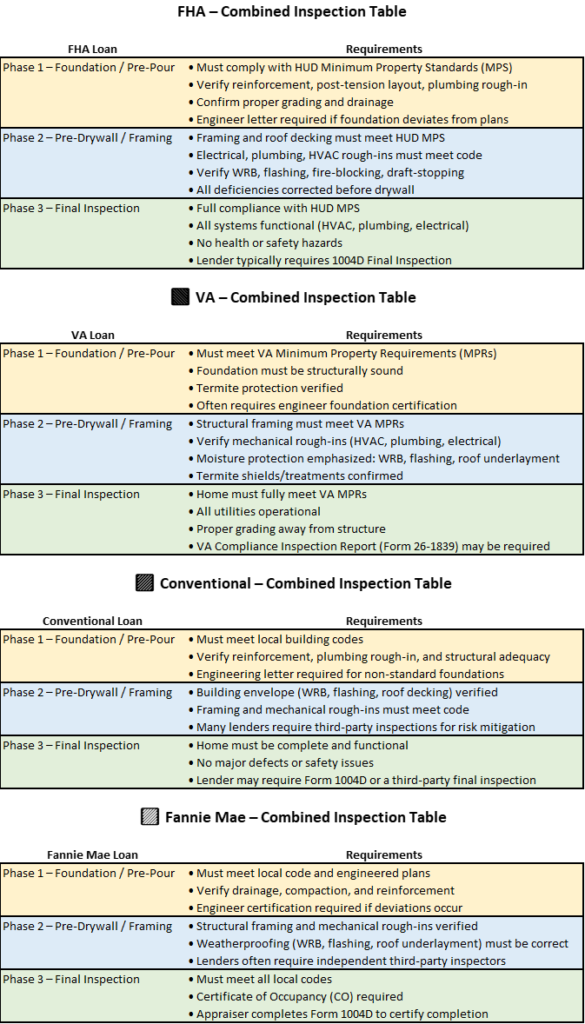
🏗️ Combined Comparison Chart
Organized by Loan Type
🧩 Authorized Inspectors for Each Loan Type
| Loan Type | Who Performs Phase 1–3 Inspections |
|---|---|
| FHA | TREC‑licensed inspectors, HUD‑approved fee inspectors, ICC‑certified inspectors, licensed engineers (if needed), appraiser only for final 1004D |
| VA | TREC‑licensed inspectors, VA‑approved compliance inspectors, licensed engineers (foundation), appraiser sometimes for final |
| Conventional | TREC‑licensed inspectors, independent third‑party inspectors (includes ICC inspectors, engineers, private inspection firms), appraiser for 1004D |
| Fannie Mae | TREC‑licensed inspectors, independent third‑party inspectors, licensed engineers (if deviations), municipal inspector (CO), appraiser for 1004D |
| Freddie Mac | TREC‑licensed inspectors, independent third‑party inspectors, licensed engineers (if deviations), municipal inspector (CO), appraiser for Form 442 (Freddie Mac’s version of the 1004D) |